1-877-861-8000
Mon-Fri, 9 AM-6 PM PT
A lift chair recliner is a recliner with a motorized base that tilts the whole chair forward to help the person in it move between sitting and standing. Choosing one comes down to the recline style (2-position, 3-position or infinite-position), how well the chair fits the person's body and how it fits the room.

Key takeaways
A lift chair recliner looks like an ordinary living room recliner, but a motorized base tilts the whole chair forward to help the person in it move between sitting and standing. Choosing one comes down to three things: how far it reclines, how well it fits the person's body and how it will fit into the room. This guide covers each in turn, with a checklist at the end.
We sell equipment, not medical advice. If you are buying a lift chair for someone recovering from surgery or managing a health condition, ask their physician or therapist which positions and features suit them.
"Position" describes how the backrest and footrest move and how far back the chair can go. There are three common styles.
The backrest and footrest are linked and the chair reclines only slightly, about enough to watch TV or read with the feet up. These chairs are usually compact and straightforward to operate. They suit people who mostly sit upright and want help standing.
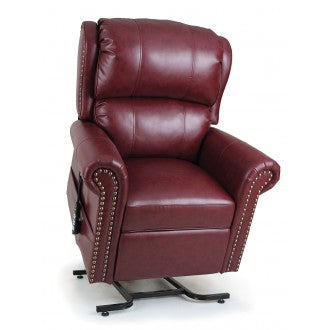
A 3-position chair still links the backrest and footrest on one motor, but it reclines further, into a napping position. The Pride Essential Collection LC-105 is an example: a two-button control moves it between upright, standing and full recline, and the chair can be stopped at any point in between. Because the back and feet move together, you cannot raise the footrest without leaning back as well.
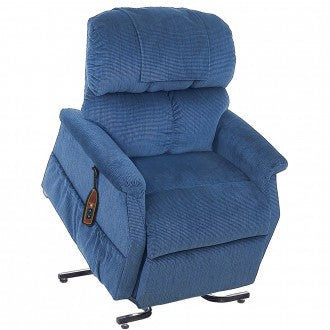
Infinite-position chairs use separate motors for the backrest and the footrest, so each can be adjusted on its own. You can sit upright with the legs raised, or lean back with the feet down. Many of these chairs can recline close to flat, and some offer a zero-gravity style position. The Pride VivaLift! Ultra, for example, has an independently adjustable backrest and footrest, plus a power headrest and lumbar adjustment. Golden Technologies uses its own positioning system on chairs such as the Golden Cloud, where the seat shifts as the chair reclines.
| 2-position | 3-position | Infinite-position | |
|---|---|---|---|
| Motors | One | One | Two or more |
| Back and footrest | Move together | Move together | Move independently |
| Recline depth | Slight | Napping recline | Deepest; some near flat |
| Controls | Simplest | Simple | More buttons and options |
| Space needed behind | Least | More | Varies; check the listed clearance |
| Typical price level | Lowest | Middle | Highest |
Lift chairs come in sizes such as petite, small, medium, large and extra-large, and the right one depends on the person, not on the room. A chair that is too deep leaves the feet dangling, while one that is too small can feel cramped and makes standing harder. Manufacturers usually list a recommended height range for each size. The VivaLift! Ultra Medium, for example, lists a user height range of roughly 5'5" to 6'1", and the LC-105 for users about 5'3" or shorter.
When you compare chairs, look at these numbers on the product page:
A practical tip: measure a chair the person already finds comfortable and compare those numbers with the listing.
Recliners need space behind and in front of them. Check the product page for the clearance the chair needs from the wall when fully reclined and the space in front when it lifts. Also consider:
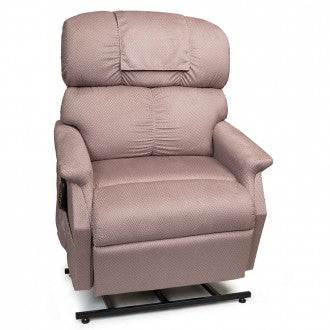
Our lift chair recliners come from Pride Mobility and Golden Technologies. Pride's range runs from the Essential Collection, which keeps the controls simple, through the Heritage Collection to the VivaLift! line, which includes several infinite-position models in multiple sizes. Golden Technologies offers chairs such as the Comforter and Cloud in sizes from junior petite up to medium-large and wide. Because each model is offered in several sizes, it is worth comparing the same chair in two sizes before you settle on one. If you see a model you like but are not sure which size to pick, send us the user's height and weight and we will point you to the listed size range.
A lift chair helps someone who can bear weight and stand with a little help. It is not a substitute for a patient lift for someone who cannot stand. If you are unsure which one fits the situation, ask a nurse or therapist.
Not sure which size or style to choose? Call 1-877-861-8000, Monday-Friday, 9 AM-6 PM Pacific, or email contactus@medsupplynow.com. You can browse every model in our lift chair recliner collection.
You may also find these useful: geri chairs and clinical recliners, positioning pillows, wedges and cushions and hospital beds for home care. For every topic we cover, see the buyer's guide hub.
A 3-position chair moves the backrest and footrest together on one motor and reclines into a napping position. An infinite-position chair has separate motors, so the back and the footrest adjust on their own, and many models recline close to flat.
Start with the manufacturer's recommended user height range on the product page, then check the weight capacity, seat width, seat depth and seat height. Comparing those numbers with a chair the person already finds comfortable helps.
Check the listed wall clearance for full recline and leave open space in front for the lift motion. Measure doorways and hallways too; many chairs ship with a removable back.
Many do. The Pride LC-105 and the Golden Cloud, for example, include a backup battery that lets the chair finish moving during an outage. Check the product page for the model you are considering.
Pride Mobility, including the Essential, Heritage and VivaLift! collections, and Golden Technologies, including the Comforter and Cloud. Our team is available at 1-877-861-8000, Monday to Friday, 9 AM to 6 PM PT.
 November 11, 2026
Bariatric Equipment Buyer's Guide: Lifts, Beds, Wheelchairs and Bathroom Aids
What to compare on bariatric lifts, beds, mattresses, wheelchairs, transport chairs, walkers and commodes, with capacities from the makers we...
 November 11, 2026
Ceiling Lifts vs. Floor Lifts: How to Choose a Ceiling or Track Lift
How ceiling lifts and floor lifts differ, the track options that need no ceiling work, and how the Voyager, Maxi...
 November 11, 2026
Sit-to-Stand Lifts: How to Choose a Stand Aid or Powered Stand Lift
How manual stand aids and powered sit-to-stand lifts differ, who they are meant for, and how the Arjo Sara, Hoyer...